
Talking About Personal Experiences
Talking about personal experiences is an important part of everyday communication. In this lesson, you'll learn how to discuss weekend activities, share stories, describe memorable events, express feelings, and ask follow-up questions. These skills will help you have more natural, engaging, and confident conversations in English.
🎯 Level: Beginner, Intermediate ⏱ Time: 20–35 minutes 📘 Categories: Real English, Speaking
🎯 What you'll learn
🧠 Practice Exercises
Think of your answer first, then click to reveal!
▼ Reveal
Friend: “What did you do this weekend?”
You: “I met up with some friends and visited a street market on Saturday.”
This is a natural way to describe a weekend activity.
▼ Reveal
❌ “On Saturday, I go shopping.”
✅ “On Saturday, I went shopping.”
Use the past simple tense when talking about a finished weekend.
▼ Reveal
❌ “I didn’t went to the concert.”
✅ “I didn’t go to the concert.”
After didn't, use the base form of the verb.
▼ Reveal
“The highlight of my weekend was trying a new taco restaurant with my family.”
A highlight is the most memorable or enjoyable part of an experience.
▼ Reveal
Instead of saying “The food was good,” you could say:
✅ “The tacos were spicy and full of flavor.”
Specific details make stories more interesting.
▼ Reveal
The ongoing action happened first:
✅ “I was walking through the park...”
The shorter action interrupted it:
✅ “...when I saw a street performer.”
▼ Reveal
Try using time linkers such as:
✅ “First...”
✅ “After that...”
✅ “Later on...”
✅ “Finally...”
These make stories sound more natural and organized.
▼ Reveal
Instead of a one-word answer, try:
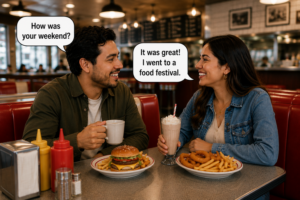
✅ “It was great. On Saturday, I visited a food festival with some friends and tried several new dishes.”
Adding details helps create a conversation.
▼ Reveal
✅ “What kept you so busy?”
Open-ended questions encourage longer and more interesting conversations.
▼ Reveal
Ask a follow-up question such as:
✅ “What did you order?”
✅ “What was the best thing you ate?”
✅ “Would you go back there?”
Follow-up questions show interest and keep the conversation flowing.
▼ Reveal
They want you to describe your experience, feelings, or impressions.
Example:
✅ “It was exciting because there was live music and great food.”
▼ Reveal
Natural reactions include:
✅ “No way! Really?”
✅ “That sounds amazing!”
✅ “That sounds so relaxing.”
✅ “Oh, I see — and then what happened?”
These expressions encourage the speaker to continue.
💳 Key Words
Talking About Weekend Activities 🗓️
When someone asks "How was your weekend?", it helps to have a variety of vocabulary to describe what you did. Using specific verbs and expressions makes your conversations more natural and interesting.
Relaxing Activities
Use these expressions when talking about rest and relaxation. 😌
Examples:
- chill out
- sleep in
- binge-watch a series
- unwind after work
Example sentence:
"On Sunday, I slept in and binge-watched a new series."
Social Activities
Use these expressions when spending time with other people. 👥
Examples:
- hang out with friends
- meet up with someone
- catch up with family
- grab a coffee
Example sentence:
"I met up with some friends and grabbed a coffee downtown."
Describing Past Experiences ⏳
Weekend conversations usually use the past simple tense because the events are finished.
Common Past Tense Verbs
go → went
eat → ate
see → saw
have → had
meet → met
Example:
"On Saturday, I went to a food festival and met some friends."
Useful Time Markers
These expressions help organize your story.
- On Friday night...
- On Saturday morning...
- Later that afternoon...
- By Sunday evening...
Example:
"By Sunday evening, I felt relaxed and ready for the new week."
Sharing a Highlight
A good story focuses on one memorable moment. 🌟
Simple formula:
- Say what happened
- Add a detail
- Describe how you felt
Example:
"The highlight of my weekend was visiting a street market. I found some handmade jewelry, and I felt really excited."
Asking Follow-Up Questions
Good conversations continue with follow-up questions. 💬
Examples:
- What was the best part?
- Who did you go with?
- What was that like?
- Tell me more about it.
Example:
"What kind of food did you try at the festival?"
| Expression | Meaning | Example |
|---|---|---|
| Chill Out 😌 | Relax and take it easy | "I chilled out at home on Sunday." |
| Sleep In 🛏️ | Stay in bed later than usual | "I slept in until 10 o’clock." |
| Hang Out 👥 | Spend time with other people | "I hung out with some friends on Saturday." |
| Catch Up With ☕ | Talk with someone after not seeing them for a while | "I caught up with an old friend over coffee." |
| Meet Up 🤝 | Arrange to see someone | "We met up at the street market." |
| Run Errands 🛒 | Do necessary everyday tasks | "I ran errands all Saturday morning." |
| Street Market 🏪 | An outdoor market with food and stalls | "We visited a street market downtown." |
| Food Festival 🌮 | An event celebrating food and local cuisine | "The food festival was crowded but fun." |
| Laid-Back 😎 | Relaxed and without pressure | "It was a laid-back weekend." |
| Hectic 😵 | Very busy and full of activity | "My weekend was hectic because of work." |
| Rewarding 🏆 | Giving a feeling of satisfaction | "Volunteering was very rewarding." |
| Highlight 🌟 | The best or most memorable part of an experience | "The highlight of my weekend was the concert." |
| Follow-Up Question 💬 | A question asked to get more details | "What was the best part of the trip?" |
| Past Simple ⏳ | A tense used for completed actions in the past | "I went to a concert on Friday." |
| Past Continuous 🎬 | A tense used for an action in progress in the past | "I was walking when it started to rain." |
💬 Speaking
▼ Reveal
1. Click the button "Practice Speaking." A new window opens.(Allow pop-up windows.)
2. Enter your name and email.
3. Give permission for your microphone.
4. Read and listen to the activity.
5. Speak and answer when it is your turn.
6. When you finish speaking, you do not need to do anything else.
7. After you finish speaking, you'll receive an evaluation and a copy of the transcript.
🎓✨ Check your Understanding
▼ Reveal
✅ Possible Answer:
"I went to a food festival."
▼ Reveal
✅ Possible Answers:
- chill out
- sleep in
- binge-watch
- unwind
▼ Reveal
✅ Possible Answer:
"I went shopping with my friends."
▼ Reveal
✅ Sample Answer:
"The highlight of my weekend was visiting a street market with my family."
▼ Reveal
✅ Possible Answers:
- On Friday night...
- On Saturday morning...
- Later that afternoon...
- By Sunday evening...
▼ Reveal
✅ Possible Answer:
"The weekend was hectic because I had so many things to do."
▼ Reveal
✅ Possible Answers:
- What did you get up to this weekend?
- What was the best part of your weekend?
- Who did you spend time with?
- What did you do on Sunday?
▼ Reveal
✅ Possible Answers:
- What was it like?
- Tell me more about it.
- Who did you go with?
- What happened next?
📝 Summary & Free Download
Download the PDF version of this lesson to review the vocabulary, and examples whenever you need them.
📤 Share this Lesson
Talking About Personal Experiences © 2026 by Joe Ehman is licensed under Creative Commons Attribution-NonCommercial-ShareAlike 4.0 International.