
This lesson helps you improve your Business English by practicing important workplace vocabulary, choosing the correct words in context, and identifying common word-choice and spelling mistakes.
Business English: Vocabulary & Common Mistakes

This lesson helps you improve your Business English by practicing important workplace vocabulary, choosing the correct words in context, and identifying common word-choice and spelling mistakes.
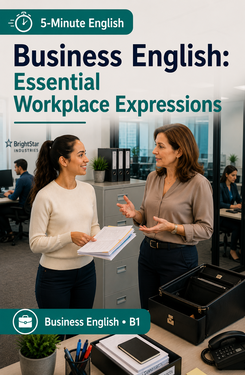
Learn essential Business English vocabulary for workplace communication, business documents, meetings, contracts, and common professional expressions.
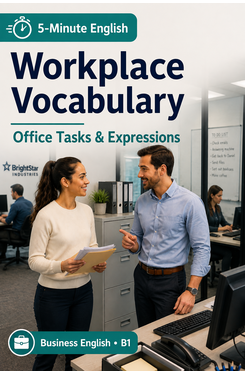
Improve your B1 Business English with this practical lesson on office vocabulary and workplace expressions. Learn useful English for everyday office tasks, including passwords, databases, files, contracts, and common expressions such as “chuck out,” “pop in,” “knock off,” and “get back to.” Practice your English with vocabulary exercises, a workplace conversation, and a comprehension quiz.
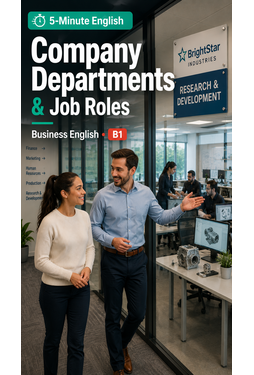
Learn essential Business English vocabulary for the workplace with this B1 lesson about company departments and job roles. Practice words related to Finance, Marketing, Production, Human Resources, and Legal departments while improving your ability to communicate confidently in a professional environment.
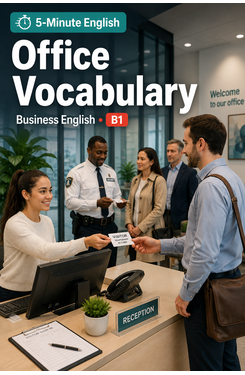
Learn essential Business English for the workplace with this lesson on office vocabulary, office assistant responsibilities, employment terms, workplace communication, and professional behavior. Practice realistic business English through vocabulary exercises and practical office scenarios to build confidence in today’s workplace.
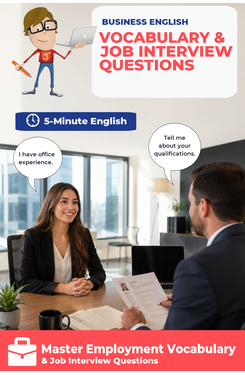
Improve your Business English with essential employment vocabulary, office terminology, and common job interview questions. Learn key workplace expressions, describe your skills and qualifications confidently, and prepare for interviews with practical examples and real-world Business English vocabulary.
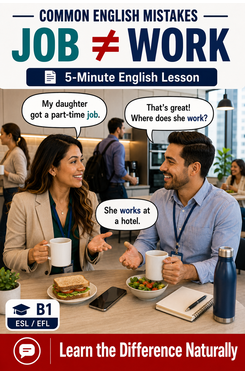
In this lesson, you learned the difference between job and work in English and how to use each word correctly in everyday conversations. You discovered that job refers to a specific occupation or position, while work describes the activities you do, your workplace, or can even be used as a verb. You also practiced common expressions such as get a job, look for a job, work as, work for, work in, and go to work. Finally, you learned how to avoid common English mistakes like saying a work or My job is a teacher, helping you speak and write more naturally and confidently in English.
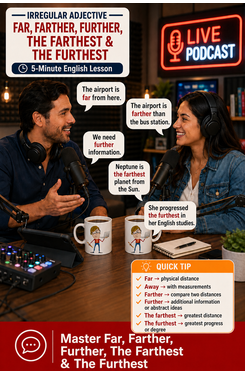
This is Part 3 of a three-part series on three common irregular adjectives in English: good, bad, and far.
In this lesson, we focus on far, exploring its different forms and how it is used naturally in everyday English. We will look at how far changes when we compare things (far → farther → the farthest), and how native speakers actually use it in real-life situations such as describing experiences, making choices, and giving opinions. You’ll also see common expressions and examples that will help you sound more natural and confident when speaking.
🎯 Level: Beginner ⏱ Time: 5 – 10 minutes 📘 Categories: Adjectives, Grammar, Vocabulary
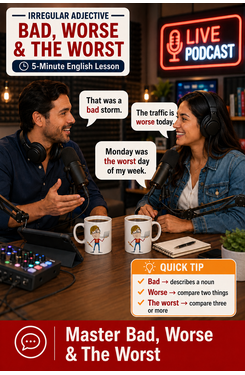
This is Part 2 of a three-part series on three common irregular adjectives in English: good, bad, and far.
In this lesson, we focus on bad, exploring its different forms and how it is used naturally in everyday English. We will look at how bad changes when we compare things (bad → worse → the worst), and how native speakers actually use it in real-life situations such as describing experiences, making choices, and giving opinions. You’ll also see common expressions and examples that will help you sound more natural and confident when speaking. 🎯 Level: Beginner ⏱ Time: 5 – 10 minutes 📘 Categories: Adjectives, Grammar, Vocabulary
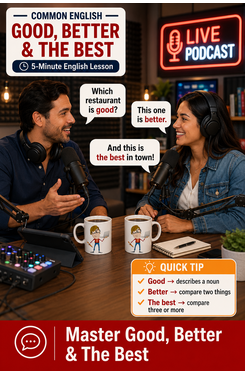
This is Part 1 of a three-part series on three common irregular adjectives in English: good, bad, and far.
In this lesson, we focus on good, exploring its different forms and how it is used naturally in everyday English. We will look at how good changes when we compare things (good → better → best), and how native speakers actually use it in real-life situations such as describing experiences, making choices, and giving opinions. You’ll also see common expressions and examples that will help you sound more natural and confident when speaking.
🎯 Level: Beginner ⏱ Time: 5 – 10 minutes 📘 Categories: Adjectives, Grammar, Vocabulary