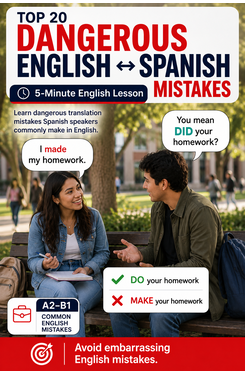
Confusing English Verbs: do, make, win, earn & more

Spanish speakers often confuse English verbs like do, make, win, earn, say, tell, lend, and borrow. Learn the correct differences, avoid common mistakes, and speak more natural everyday English with simple explanations, examples, dialogues, and practice exercises.

🎯 Level: Beginner, Intermediate ⏱ Time: 10 – 15 minutes 📘 Categories: Common Mistakes

read more

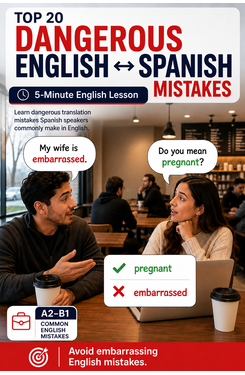
Top 20 Dangerous Spanish ↔ English Translations

Spanish speakers often confuse false cognates because some English and Spanish words look similar but have different meanings. Learning words like “assist,” “library,” “actually,” and “sensible” helps learners avoid misunderstandings, communicate naturally, and prevent embarrassing or dangerous translation mistakes.

🎯 Level: Beginner, Intermediate ⏱ Time: 20–35 minutes 📘 Categories: Common Mistakes

read more

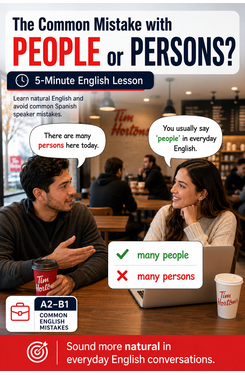
Common Mistakes – Singular -vs- Plural

This lesson explains common singular and plural mistakes Spanish speakers make in English, especially “people” versus “persons.” Learners practice natural everyday English, uncountable nouns, and common grammar corrections through realistic conversations and examples..

🎯 Level: Beginner, Intermediate ⏱ Time: 10–15 minutes 📘 Categories: Common Mistakes

read more

Failure -vs- Inoperable

Understand the difference between failure and inoperable, two commonly confused words. Learn when to describe an unsuccessful result and when to describe something that cannot function. With simple explanations and practical examples, you’ll avoid common mistakes and use both words accurately in everyday English.

read more

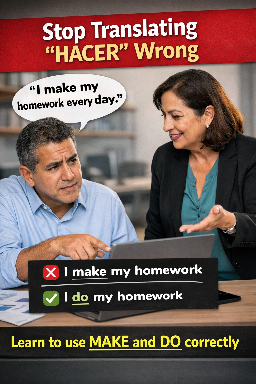
Make -vs- Do

Learn the difference between make and do, two common verbs often confused by Spanish speakers. Understand key patterns, collocations, and when to use each verb correctly. Practice with examples and avoid typical mistakes caused by translating “hacer.” Improve your accuracy and confidence using make and do in everyday English.

read more

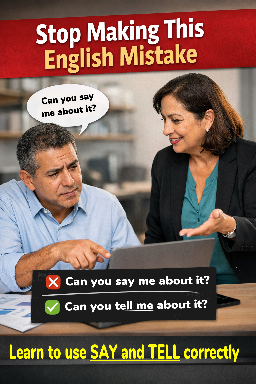
Say -vs- Tell

Learn the difference between “say” and “tell” in English. Use “say” for the message and “tell” for the person receiving it. Remember the structure “tell + someone + to + verb” for instructions. Avoid common mistakes like “say me” and “tell that.” Master key expressions and improve accuracy in everyday communication quickly.

read more

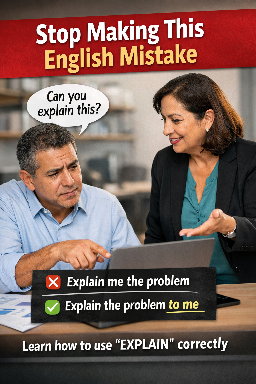
The verb “Explain”

Many English learners say **“Explain me”**, but it’s incorrect. Learn how to use the verb **explain** correctly with clear grammar patterns, examples, and common mistakes to avoid. Improve your English communication and start explaining ideas clearly and naturally in everyday conversations.

read more

Common Mistakes 2

Grammar Patterns Spanish Speakers Get Wrong
❌ What’s the problem?
Some English sentences follow different patterns than Spanish — even when the words seem similar.

read more