
Common Mistakes – Singular -vs- Plural

★★★★★Common Mistakes

Common Mistakes Singular -vs- Plural

This lesson explains common singular and plural mistakes Spanish speakers make in English, especially “people” versus “persons.” Learners practice natural everyday English, uncountable nouns, and common grammar corrections through realistic conversations and examples..

🎯 Level: Beginner, Intermediate Time: 20–35 minutes 📘 Categories: Common Mistakes

🎯 What you'll learn

1
Why “people” is the normal plural of “person” in everyday English
2
When “persons” is used in formal or legal situations
3
How Spanish speakers commonly confuse “people” and “persons”
4
Common mistakes with singular and plural nouns in English
5
How to avoid mistakes with uncountable nouns like “information” and “advice”
6
The correct way to use irregular plurals like “children” and “people”
7
Simple examples you can use in everyday conversations

🧠 Practice Exercises

Think of your answer first, then click to reveal!

Your friend says: “There are many persons at the party.” What do you say?
▼ Reveal
✅ Answer:

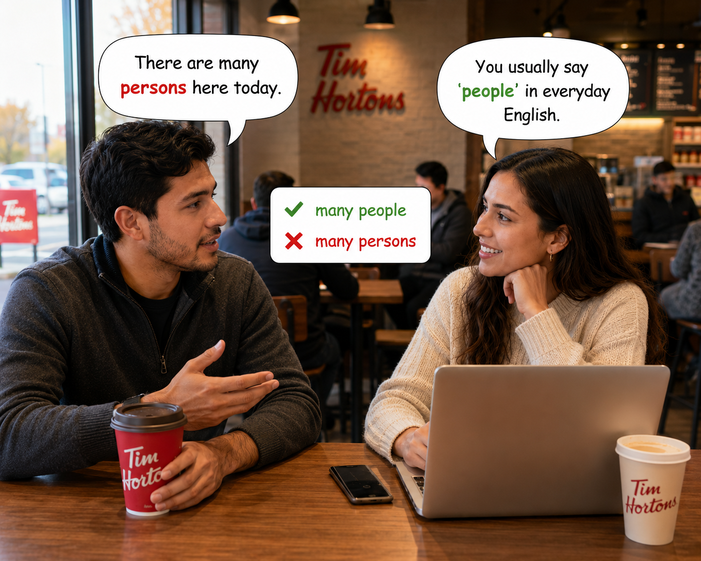
Friend: “There are many persons at the party.”
You: “In everyday English, we usually say ‘people.’”

✅ Correct sentence: “There are many people at the party.”

Someone says: “I need more informations.” What is the correct sentence?
▼ Reveal
✅ Answer:

❌ “I need more informations.”
✅ “I need more information.”

“Information” is an uncountable noun in English.

A student says: “The teacher gave us many homeworks.” What do you say?
▼ Reveal
✅ Answer:

❌ “many homeworks”
✅ “a lot of homework”

Correct sentence: “The teacher gave us a lot of homework.”

Your coworker says: “I have two brother.” What is the mistake?
▼ Reveal
✅ Answer:

After numbers, nouns are usually plural in English.

❌ “two brother”
✅ “two brothers”

Someone says: “She gave me good advices.” How do you correct it?
▼ Reveal
✅ Answer:

❌ “good advices”
✅ “good advice”

“Advice” is uncountable in English.

A parent says: “The childs are sleeping.” What is the correct sentence?
▼ Reveal
✅ Answer:

❌ “childs”
✅ “children”

Correct sentence: “The children are sleeping.”

Someone says: “The news are good.” Is that correct?
▼ Reveal
✅ Answer:

❌ “The news are good.”
✅ “The news is good.”

“News” is singular in English.

You hear: “Can you give me an information?” What is the correct version?
▼ Reveal
✅ Answer:

❌ “an information”
✅ “some information”

Correct sentence: “Can you give me some information?”

💳 Key Words

People vs. Persons 👥

Many Spanish speakers are confused about the difference between people and persons. They both come from the word person, but they are used differently in English.

People

People is the normal plural of person. 👨‍👩‍👧‍👦

Native speakers use it in everyday conversation.

Example:
"There are many people at the restaurant."

Common situations:

  • Talking about groups
  • Daily conversation
  • Friends and family
  • School or work
Persons

Persons is much more formal. ⚖️

It is mostly used in legal language, signs, or official documents.

Example:
"Unauthorized persons are not allowed."

Common situations:

  • Police reports
  • Legal documents
  • Official signs
  • Formal notices

Other Common Singular & Plural Mistakes 📚

Some English nouns are uncountable, so they do not usually use a plural form.

Information

❌ informations
✅ information

Example:
"Can you give me some information?"

Advice

❌ advices
✅ advice

Example:
"She gave me good advice."

Homework

❌ homeworks
✅ homework

Example:
"We have a lot of homework tonight."

News

❌ The news are good.
✅ The news is good.

Important:
"News" is singular in English.

Word Meaning Example
Person 👤 One human being "There is one person in the office."
People 👥 The normal plural of person "Many people are waiting outside."
Persons ⚖️ A formal or legal plural of person "Unauthorized persons are not allowed."
Singular 1️⃣ A word for one thing or person "Child" is singular.
Plural 🔢 A word for more than one thing or person "Children" is plural.
Countable 🔢 Something you can count "I have two books."
Uncountable 🌊 Something you usually cannot count individually "We need more information."
Information 📚 Facts or details "Can you give me some information?"
Advice 💡 Suggestions or recommendations "She gave me good advice."
Homework 📝 School work students do at home "I have a lot of homework tonight."
News 📰 Information about recent events "The news is good today."
Children 👦👧 Plural form of child "The children are playing."
Mistake ❌ Something incorrect "That sentence has a mistake."
Correct ✅ Right or accurate "Your answer is correct."

🎧 Listening

Listen to 4 conversations of people ordering drinks in a restaurant. After listening, answer the questions below.


4 Dialogues
▼ Reveal

✅ Script:

1. At the Shopping Mall

Sofia: Wow, there are so many persons here today.
Emma: In English, we usually say “people,” not “persons.”

Sofia: Oh right! There are so many people here today.
Emma: Exactly. “Persons” sounds very formal.

Sofia: When do people use “persons”?
Emma: Usually in legal language or official signs.

Sofia: Got it! Everyday English uses “people.”


2. In the Classroom

Teacher: Please read the sentence aloud.
Carlos: “She gave me many advices.”

Teacher: Almost correct. “Advice” is uncountable.
Carlos: So I should say “many advice”?

Teacher: Not exactly. We usually say “a lot of advice” or “good advice.”
Carlos: Okay. “She gave me good advice.”

Teacher: Perfect!


3. Talking About Homework

Mia: Do we have a lot of homeworks tonight?
Jake: We usually say “homework,” not “homeworks.”

Mia: Really? Even if there are many assignments?
Jake: Yes. “Homework” is uncountable in English.

Mia: English has many strange rules.
Jake: It does, but you’re improving quickly.

Mia: Thanks! I’ll remember that.


4. Watching the News

Daniel: The news are very depressing today.
Laura: Small correction — we say “The news is…”

Daniel: Why? “News” sounds plural.
Laura: I know, but in English it uses a singular verb.

Daniel: So I should say, “The news is depressing today”?
Laura: Exactly. That sounds natural.

❓ Answer the questions. Think of your answers first, then click to check!

Dialogue 1 – What word did Sofia use incorrectly?
▼ Reveal
✅ Answer:
Sofia incorrectly used the word “persons.”
Dialogue 1 – What word should Sofia use in everyday English?
▼ Reveal
✅ Answer:
She should use the word “people.”

Dialogue 2 – What mistake did Carlos make?
▼ Reveal
✅ Answer:
Carlos said “advices” instead of “advice.”
Dialogue 2 – Is “advice” countable or uncountable?
▼ Reveal
✅ Answer:
“Advice” is uncountable.

Dialogue 3 – What incorrect word did Mia use?
▼ Reveal
✅ Answer:
Mia incorrectly used the word “homeworks.”
Dialogue 3 – What is the correct word?
▼ Reveal
✅ Answer:
The correct word is “homework.”

Dialogue 4 – What mistake did Daniel make?
▼ Reveal
✅ Answer:
Daniel said “The news are…” instead of “The news is…”
Dialogue 4 – Does “news” use a singular or plural verb in English?
▼ Reveal
✅ Answer:
“News” uses a singular verb in English.

💬 Speaking

This is a new speaking practice feature in 5 Minute English.

How to use
▼ Reveal

✅ Script:

1. Click the button "Speaking Practice." A new window opens.(Allow pop-up windows.)
2. Enter your name and email.
3. Give permission for your microphone.
4. Read and listen to the activity.
5. Speak and answer when it is your turn.
6. When you finish speaking, you do not need to do anything else.

🎓✨ Check your Understanding

“Persons” is the most common plural of “person” in everyday English. Is this TRUE or FALSE?
▼ Reveal

✅ Answer:

This statement is false.

In everyday English, native speakers usually say “people”, not “persons.”

What is the normal plural of “person” in everyday conversation?
▼ Reveal

✅ Answer:

The normal plural of “person” is “people.”

When is the word “persons” commonly used?
▼ Reveal

✅ Answer:

“Persons” is commonly used in formal situations such as legal documents, police reports, and official signs.

Which sentence is correct?
A) “There are many persons at the mall.”
B) “There are many people at the mall.”
▼ Reveal

✅ Answer:

B) “There are many people at the mall.”

Is “information” countable or uncountable in English?
▼ Reveal

✅ Answer:

“Information” is uncountable in English.

Which sentence is correct?
A) “She gave me good advices.”
B) “She gave me good advice.”
▼ Reveal

✅ Answer:

B) “She gave me good advice.”

Why is “homeworks” incorrect in English?
▼ Reveal

✅ Answer:

Because “homework” is an uncountable noun and normally does not have a plural form.

What is the correct plural of “child”?
▼ Reveal

✅ Answer:

The correct plural of “child” is “children.”

Which sentence is correct?
A) “The news are good.”
B) “The news is good.”
▼ Reveal

✅ Answer:

B) “The news is good.”

What should you usually say in everyday English: “people” or “persons”?
▼ Reveal

✅ Answer:

You should usually say “people” in everyday English.

📝 Summary

1
“People” is the normal plural of “person” in everyday English.
2
“Persons” is mostly used in formal, legal, or official situations.
3
Spanish speakers often overuse “persons” because of direct translation from “personas.”
4
Many English nouns are uncountable and usually do not have plural forms.
5
Words like “information,” “advice,” and “homework” are uncountable in English.
6
Irregular plurals are common in English, such as “child” → “children.”
7
The word “news” looks plural, but it uses singular verbs in English.
8
Learning common singular and plural patterns helps Spanish speakers sound more natural in English conversations.

📤 Share this Lesson

Common Mistakes Singular -vs- Plural © 2026 by Joe Ehman is licensed under Creative Commons Attribution-NonCommercial-ShareAlike 4.0 International.