
Weekend: Activities in English. Practice common weekend activities with these 15 visual flashcards. Learn useful vocabulary for talking about how you spend your free time and what you like to do on the weekend.
Weekend Activities
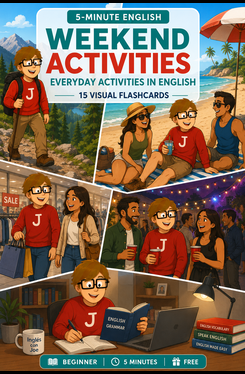
Weekend: Activities in English. Practice common weekend activities with these 15 visual flashcards. Learn useful vocabulary for talking about how you spend your free time and what you like to do on the weekend.
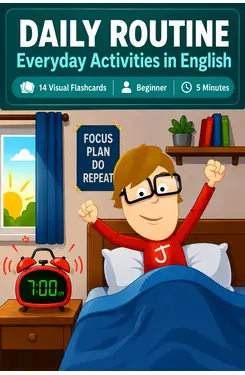
★★★★★ Flashcards Daily Routine: Everyday Activities in English Practice everyday activities in English with these 14 visual flashcards. 👋 Look at the picture on the front of each card and think about the English expression for the activity. Click or tap the card to flip it and check your answer….
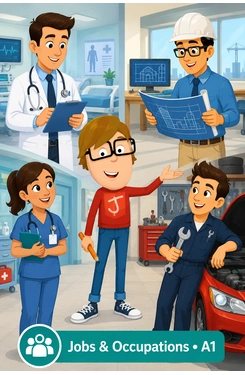
★★★★★ Flashcards Jobs in English: 12 Common Occupations Let’s practice jobs in English! 👋 These 12 flashcards will help you learn 12 common job names in a simple, visual way. Look at the picture on the front of each card and try to identify the job. Click or tap the card…
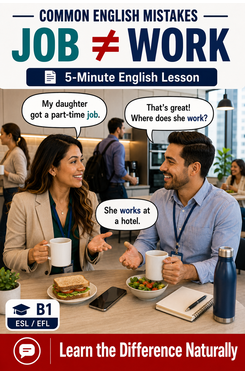
In this lesson, you learned the difference between job and work in English and how to use each word correctly in everyday conversations. You discovered that job refers to a specific occupation or position, while work describes the activities you do, your workplace, or can even be used as a verb. You also practiced common expressions such as get a job, look for a job, work as, work for, work in, and go to work. Finally, you learned how to avoid common English mistakes like saying a work or My job is a teacher, helping you speak and write more naturally and confidently in English.
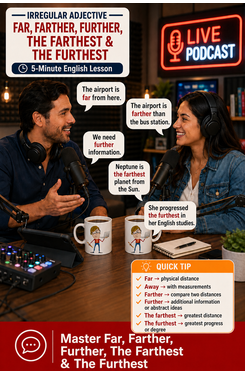
This is Part 3 of a three-part series on three common irregular adjectives in English: good, bad, and far.
In this lesson, we focus on far, exploring its different forms and how it is used naturally in everyday English. We will look at how far changes when we compare things (far → farther → the farthest), and how native speakers actually use it in real-life situations such as describing experiences, making choices, and giving opinions. You’ll also see common expressions and examples that will help you sound more natural and confident when speaking.
🎯 Level: Beginner ⏱ Time: 5 – 10 minutes 📘 Categories: Adjectives, Grammar, Vocabulary
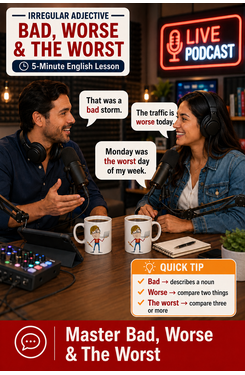
This is Part 2 of a three-part series on three common irregular adjectives in English: good, bad, and far.
In this lesson, we focus on bad, exploring its different forms and how it is used naturally in everyday English. We will look at how bad changes when we compare things (bad → worse → the worst), and how native speakers actually use it in real-life situations such as describing experiences, making choices, and giving opinions. You’ll also see common expressions and examples that will help you sound more natural and confident when speaking. 🎯 Level: Beginner ⏱ Time: 5 – 10 minutes 📘 Categories: Adjectives, Grammar, Vocabulary
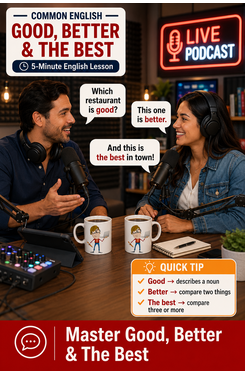
This is Part 1 of a three-part series on three common irregular adjectives in English: good, bad, and far.
In this lesson, we focus on good, exploring its different forms and how it is used naturally in everyday English. We will look at how good changes when we compare things (good → better → best), and how native speakers actually use it in real-life situations such as describing experiences, making choices, and giving opinions. You’ll also see common expressions and examples that will help you sound more natural and confident when speaking.
🎯 Level: Beginner ⏱ Time: 5 – 10 minutes 📘 Categories: Adjectives, Grammar, Vocabulary
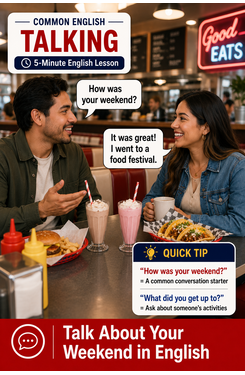
Talking about personal experiences is an important part of everyday communication. In this lesson, you’ll learn how to discuss weekend activities, share stories, describe memorable events, express feelings, and ask follow-up questions. These skills will help you have more natural, engaging, and confident conversations in English.
🎯 Level: Beginner, Intermediate ⏱ Time: 20–35 minutes 📘 Categories: Real English, Speaking
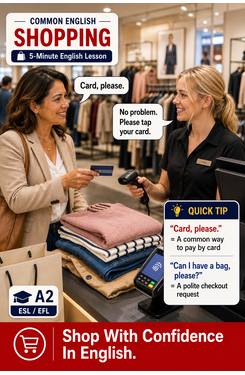
Shopping & Assistance
In this lesson, you’ll learn practical English for shopping confidently. You’ll discover how to ask for help, find products, discuss prices, request sizes and colors, make payments, and handle common supermarket and retail conversations naturally and politely in English.
🎯 Level: Beginner, Intermediate ⏱ Time: 20–35 minutes 📘 Categories: Speaking, Real English
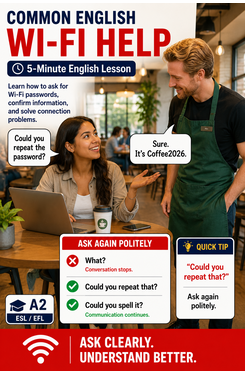
In this lesson, you’ll learn how to ask for clarification, request slower speech, confirm information, ask for help at tourist information offices, and request Wi-Fi passwords confidently. These practical communication skills will help you avoid misunderstandings and navigate real-world situations more effectively.
🎯 Level: Beginner, Intermediate ⏱ Time: 20–35 minutes 📘 Categories: Speaking, Real English