
Shopping & Assistance
In this lesson, you'll learn practical English for shopping confidently. You'll discover how to ask for help, find products, discuss prices, request sizes and colors, make payments, and handle common supermarket and retail conversations naturally and politely in English.
🎯 Level: Beginner, Intermediate ⏱ Time: 20–35 minutes 📘 Categories: Speaking, Real English
🎯 What you'll learn
🧠 Practice Exercises
Think of your answer first, then click to reveal!
▼ Reveal
✅ Politely get the assistant’s attention.
Correct sentence: “Excuse me, could you help me, please?”
▼ Reveal
✅ Describe what the item is used for.
Example sentence: “It’s something you use to charge your phone.”
▼ Reveal
✅ Ask where you can find the item.
Example question: “Where can I find the notebooks?”
▼ Reveal
✅ Ask directly about the price.
Correct question: “How much is this?”
▼ Reveal
✅ Ask if the item is discounted.
Example question: “Is this on sale?”
▼ Reveal
✅ Ask for the size you need.
Correct question: “Do you have this in a size 10?”
▼ Reveal
✅ Ask if another color is available.
Correct question: “Do you have this shirt in black?”
▼ Reveal
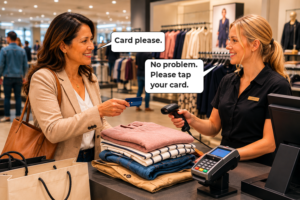
✅ Tell the cashier your payment method.
Example sentence: “Card, please.”
▼ Reveal
✅ Politely request a bag.
Correct sentence: “Can I have a bag, please?”
▼ Reveal
✅ Answer simply and directly.
Correct sentence: “No, I don’t.” or, if you have a loyalty card: "Yes, I do."
💳 Key Phrases
Asking for Help in a Store
When you need assistance, start by getting a shop assistant's attention politely.
Useful phrases:
Example:
You: "Excuse me, could you help me, please?"
Assistant: "Of course. What are you looking for?"
Being polite and specific helps you get assistance quickly and confidently.
Asking About Prices
Before buying something, you often need to check the price or ask about discounts.
Useful phrases:
Understanding prices, discounts, and promotions helps you make better shopping decisions.
Asking for a Specific Size or Color
When shopping for clothing, you may need a different size or color than the one on display.
Useful phrases:
Example:
You: "Do you have this skirt in a size 6, in yellow?"
Assistant: "We have it in yellow, but only in a size 8."
Learning these phrases makes clothes shopping much easier and more successful.
Paying and Checking Out
At the checkout, you'll need to choose a payment method and possibly ask for a bag.
Useful phrases:
Cashiers may also ask questions such as "Do you have a loyalty card?" or "Do you need a bag?" Understanding these common interactions helps you complete purchases smoothly and confidently.
| Situation | Useful Phrase | Example |
|---|---|---|
| Getting a Shop Assistant's Attention 🙋 | Excuse me, could you help me, please? | "Excuse me, could you help me, please? I'm looking for a phone charger." |
| Explaining What You Need 🎁 | I'm looking for... | "I'm looking for a birthday gift for my sister." |
| Describing an Item You Can't Name 💡 | It's something you use to... | "It's something you use to charge your phone." |
| Finding Products in a Store 🛒 | Where can I find...? | "Where can I find the milk" |
| Locating a Store Section 📍 | Is there a section for...? | "Is there a section for children's clothes?" |
| Asking About Prices 💲 | How much is this? | "How much is this jacket?" |
| Checking for Discounts 🏷️ | Is there a discount on this? | "Is there a discount on this laptop?" |
| Checking if an Item is on Sale 🔖 | Is this on sale? | "Is this on sale, or is this the regular price?" |
| Comparing Prices ⚖️ | What's the difference in price? | "What's the difference in price between these two blouses?" |
| Requesting a Specific Size 📏 | Do you have this in a size...? | "Do you have this in a size 10?" |
| Requesting a Different Color 🎨 | Do you have this in...? | "Do you have this shirt in red?" |
| Trying on Clothes 👕 | Can I try...? | "Can I try the smaller size?" |
| Finding the Fitting Rooms 🚪 | Where are the dressing rooms? | "Where are the dressing rooms, please?" |
| Checking Stock Availability 📦 | Will you get more soon? | "This size is sold out. Will you get more soon?" |
| Asking for Alternatives 🔄 | Is there something similar? | "You don't have this model. Is there something similar?" |
| Requesting a Recommendation ⭐ | What do you recommend? | "I'm not sure about this one. What do you recommend?" |
| Paying by Card 💳 | I'll pay by card. | Cashier: "Cash or card?" You: "I'll pay by card." |
| Paying with Cash 💵 | I'll pay with cash. | "I only have cash, so I'll pay with cash." |
| Using Contactless Payment 📲 | Do you take contactless? | "Do you take contactless, or do I need to insert my card?" |
| Splitting a Payment 💰 | Can I split the payment? | "Can I split the payment between two cards?" |
| Handling a Card Problem ⚠️ | The machine isn't reading my card. | "The machine isn't reading my card. Can I try again?" |
| Requesting a Bag 🛍️ | Can I have a bag, please? | "These items are heavy. Can I have a bag, please?" |
| Choosing a Bag Type 📦 | Plastic or paper? | Cashier: "Plastic or paper?" You: "Paper is fine." |
| Requesting Extra Bags 🛍️🛍️ | Could I have two bags, please? | "The bottles are heavy. Could I have two bags, please?" |
| Using a Loyalty Card ⭐ | Do you have a loyalty card? | Cashier: "Do you have a loyalty card?" You: "Yes, here it is." |
| Questioning a Price 🔍 | I think there's a mistake. | "I think there's a mistake—the sign said 35 dollars." |
| Ending the Interaction 😊 | Thanks so much for your help! | "Thanks so much for your help! Have a great day." |
💬 Speaking
▼ Reveal
1. Click the button "Practice Speaking." A new window opens.(Allow pop-up windows.)
2. Enter your name and email.
3. Give permission for your microphone.
4. Read and listen to the activity.
5. Speak and answer when it is your turn.
6. When you finish speaking, you do not need to do anything else.
7. After you finish speaking, you'll receive an evaluation and a copy of the transcript.
🎓✨ Check your Understanding
▼ Reveal
✅ Answer:
A polite way to ask for help is:
"Excuse me, could you help me, please?"
This is one of the most common ways to start a conversation with a shop assistant.
▼ Reveal
✅ Answer:
FALSE.
You can describe the item instead. For example: "It's something you use to charge your phone."
▼ Reveal
✅ Answer:
A useful question is:
"Where can I find the notebooks?"
This helps you locate products quickly in larger stores.
▼ Reveal
✅ Answer:
TRUE.
It is the most common and natural way to ask for the price of a single item.
▼ Reveal
✅ Answer:
You can ask:
"Is this on sale?"
or
"Is there a discount on this?"
Both questions help you find out if the item costs less than usual.
▼ Reveal
✅ Answer:
A useful question is:
"Do you have this in a size 10?"
You can replace the size number with the size you need.
▼ Reveal
✅ Answer:
FALSE.
You can ask:
"Is there something similar?"
or
"What would you suggest instead?"
▼ Reveal
✅ Answer:
You could say:
"Card, please."
or
"I'll pay by card."
▼ Reveal
✅ Answer:
A polite request is:
"Can I have a bag, please?"
This is commonly used at supermarkets and retail stores.
▼ Reveal
✅ Answer:
TRUE.
Checking your receipt immediately makes it easier to correct pricing or payment mistakes before leaving the store.
📝 Summary & Free Download
📤 Share this Lesson
Shopping © 2026 by Joe Ehman is licensed under Creative Commons Attribution-NonCommercial-ShareAlike 4.0 International.