
Information & Assistance
In this lesson, you'll learn how to ask for clarification, request slower speech, confirm information, ask for help at tourist information offices, and request Wi-Fi passwords confidently. These practical communication skills will help you avoid misunderstandings and navigate real-world situations more effectively.
🎯 Level: Beginner, Intermediate ⏱ Time: 20–35 minutes 📘 Categories: Speaking, Real English
🎯 What you'll learn
🧠 Practice Exercises
Think of your answer first, then click to reveal!
▼ Reveal
✅ Use a polite clarification phrase.
Correct sentence: “Sorry, can you repeat that?”
▼ Reveal
✅ Ask about the specific information you missed.
Correct question: “Sorry, which room?”
▼ Reveal
✅ Politely ask them to slow down.
Correct sentence: “Could you speak a little slower, please?”
▼ Reveal
✅ Give a simple reason.
Correct sentence: “I'm still learning English — would you mind slowing down?”
▼ Reveal
✅ Paraphrase the information.
Correct phrase: “So, you mean that...”
This gives the speaker a chance to confirm or correct you.
▼ Reveal
✅ Use a confirmation question.
Correct example: “Let me check — the meeting is Thursday at 3, not Tuesday?”
▼ Reveal
✅ Ask directly and clearly.
Correct sentence: “How do I get to the main square?”
▼ Reveal
✅ Request information materials.
Correct sentence: “Could I get a brochure about local attractions?”
▼ Reveal
✅ Ask politely.
Correct sentence: “Excuse me, could I get the Wi-Fi password, please?”
▼ Reveal
✅ Ask for clarification.
Correct question: “Could you spell that, please?”
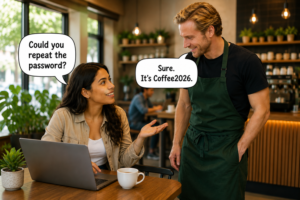
You can also ask: “Can you repeat the password slowly?”
💳 Key Phrases
Getting Information and Assistance 🗣️
Many English learners worry about making mistakes when they don't understand something. In reality, successful communication often depends on asking for help, checking information, and requesting clarification when necessary.
A confident English speaker is not someone who understands everything immediately. A confident speaker knows how to ask questions, confirm details, and get the information they need.
Asking for Clarification
Sometimes you miss a word, a number, or an important detail. Instead of guessing, ask for clarification.
Useful phrases:
• "Sorry, can you repeat that?"
• "Could you say that again, please?"
• "I didn't catch that."
• "What was the last word?"
• "Could you repeat the number, please?"
Example:
Speaker: "The meeting is in Room 204."
You: "Sorry, which room?"
Asking specific questions helps you get the information you need quickly and accurately.
Asking Someone to Speak More Slowly
Native speakers often speak quickly, making English difficult to understand.
If you need help, use polite requests such as:
• "Could you speak a little slower, please?"
• "I'm still learning English."
• "Sorry, that was a bit fast for me."
• "Could you say that again slowly?"
Remember that asking someone to slow down is completely normal and helps avoid misunderstandings.
Checking That You Understand Correctly
Good communication involves confirming information before taking action.
Useful phrases include:
• "So, you mean that..."
• "Let me see if I got that right."
• "In other words..."
• "Just to confirm..."
Example:
Staff: "The tour starts at 11:30."
You: "So, you mean the museum opens at 10, but the tour starts at 11:30?"
This simple habit prevents many common communication mistakes.
Getting Help at a Tourist Information Office
Tourist information offices can help with maps, directions, transportation, tickets, and local attractions.
Useful questions:
• "Do you have a city map?"
• "How do I get to the main square?"
• "What time does the museum open?"
• "Are there any events happening this week?"
• "Can you recommend a guided tour in English?"
The more specific your question is, the more useful the information will be.
Common Information and Assistance Mistakes ⚠️
- Pretending you understood when you did not.
- Being afraid to ask someone to repeat information.
- Not asking people to slow down when they speak too quickly.
- Failing to confirm important details such as times, prices, or locations.
- Asking very general questions instead of specific ones.
- Nodding even when you are confused.
- Guessing passwords, directions, or instructions instead of checking them.
- Waiting too long before asking for clarification.
Quick Tip 🎯
A useful communication formula is:
Listen → Clarify → Confirm
Example:
Speaker: "The bus leaves at 3:30."
You: "Sorry, could you repeat that?"
Speaker: "The bus leaves at 3:30."
You: "Just to confirm, the bus leaves at 3:30?"
This simple pattern helps you avoid misunderstandings and communicate with confidence in English.
| Situation | Useful Phrase | Example |
|---|---|---|
| Asking for Repetition 🔄 | Could you say that again, please? | "Sorry, could you say that again, please?" |
| Missing Specific Information 🎯 | Which room? | "Sorry, which room?" |
| Asking Someone to Slow Down 🐢 | Could you speak a little slower, please? | "Sorry, that was a bit fast for me." |
| Confirming Information ✔️ | Just to confirm... | "Just to confirm, the meeting is Thursday at 3?" |
| Checking Understanding 🧠 | So, you mean that... | "So, you mean the tour starts at 11:30?" |
| Requesting a Map 🗺️ | Do you have a city map? | "Do you have a city map?" |
| Asking for Directions 📍 | How do I get to...? | "How do I get to the main square?" |
| Checking Opening Hours 🕒 | What time does it open? | "What time does the museum open?" |
| Asking for Wi-Fi 📶 | Could I get the Wi-Fi password, please? | "Excuse me, could I get the Wi-Fi password, please?" |
| Clarifying a Password 🔑 | Could you spell that, please? | "Is that capital B or lowercase b?" |
💬 Speaking
▼ Reveal
1. Click the button "Practice Speaking." A new window opens.(Allow pop-up windows.)
2. Enter your name and email.
3. Give permission for your microphone.
4. Read and listen to the activity.
5. Speak and answer when it is your turn.
6. When you finish speaking, you do not need to do anything else.
7. After you finish speaking, you'll receive an evaluation and a copy of the transcript.
🎓✨ Check your Understanding
▼ Reveal
✅ Answer:
A useful question is:
"Could you spell that?"
This is especially helpful with unfamiliar names.
▼ Reveal
✅ Answer:
FALSE.
Clarifying information prevents misunderstandings and communication mistakes.
▼ Reveal
✅ Answer:
Leaning forward slightly and maintaining attention can show that you are engaged and trying to follow the conversation.
▼ Reveal
✅ Answer:
FALSE.
Use a calm, relaxed tone when making the request.
▼ Reveal
✅ Answer:
Paraphrasing shows that you listened and gives the speaker an opportunity to correct misunderstandings.
▼ Reveal
✅ Answer:
FALSE.
It is better to clarify immediately than create confusion later.
▼ Reveal
✅ Answer:
"Do I need to book in advance?"
This is a common question at tourist information offices.
▼ Reveal
✅ Answer:
"Are there any festivals happening this week?"
This can help you discover local events and activities.
▼ Reveal
✅ Answer:
"Does it have any numbers?"
Confirming details can help you enter the password correctly.
▼ Reveal
✅ Answer:
"It says incorrect password. Could you check it?"
This is a polite way to ask for assistance.
📝 Summary
📤 Share this Lesson
Information & Assistance © 2026 by Joe Ehman is licensed under Creative Commons Attribution-NonCommercial-ShareAlike 4.0 International.