Failure -vs- Inoperable

Understand the difference between failure and inoperable, two commonly confused words. Learn when to describe an unsuccessful result and when to describe something that cannot function. With simple explanations and practical examples, you’ll avoid common mistakes and use both words accurately in everyday English.

read more

Make -vs- Do

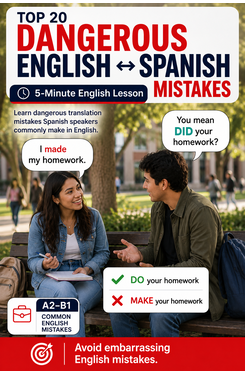
Learn the difference between make and do, two common verbs often confused by Spanish speakers. Understand key patterns, collocations, and when to use each verb correctly. Practice with examples and avoid typical mistakes caused by translating “hacer.” Improve your accuracy and confidence using make and do in everyday English.

read more

Say -vs- Tell

Learn the difference between “say” and “tell” in English. Use “say” for the message and “tell” for the person receiving it. Remember the structure “tell + someone + to + verb” for instructions. Avoid common mistakes like “say me” and “tell that.” Master key expressions and improve accuracy in everyday communication quickly.

read more

The verb “Explain”

Many English learners say **“Explain me”**, but it’s incorrect. Learn how to use the verb **explain** correctly with clear grammar patterns, examples, and common mistakes to avoid. Improve your English communication and start explaining ideas clearly and naturally in everyday conversations.

read more

What do you do?

Learn how to talk about jobs in English. In this Level 1A lesson, you’ll practice simple questions and answers like “What do you do?” and “What’s your job?” while learning common job vocabulary for everyday conversations.

read more

Reductions in English: D+Y→/j/ & D+T→/ch/

In spoken English, sounds often blend together to make speech faster and smoother. This is called reduction. In this lesson, you’ll learn how D + Y and T + Y combine to create new sounds like “j” and “ch.” Mastering these patterns will help you understand native speakers and sound more natural. Let’s get started.

read more

3 Ways to Pronounce Final S

The final S in English doesn’t always sound the same. Sometimes it’s /s/, sometimes /z/, and sometimes /ɪz/. In this lesson, you’ll learn the simple pronunciation rule that explains the difference — plus practice examples to help you speak more naturally and confidently.

🎁 Download the free Final S pronunciation tables with verbs, plural nouns, and possessives to keep practicing.

read more

Using Articles (a, an, the)

This lesson covers a core grammar structure (articles: a, an, the). It uses simple examples and everyday vocabulary, focuses on clear rules with basic practice and includes simple geography rules.

read more

Direct vs Indirect Questions

This lesson explains the difference between direct and indirect questions at B2 level. You’ll learn how to remove inversion, eliminate do/does/did, and use polite introductory phrases like “Could you tell me…” and “Do you know…”. Includes clear explanations, transformation charts, and examples in all major verb tenses.

read more