
Direct vs Indirect Questions

This lesson explains the difference between direct and indirect questions at B2 level. You’ll learn how to remove inversion, eliminate do/does/did, and use polite introductory phrases like “Could you tell me…” and “Do you know…”. Includes clear explanations, transformation charts, and examples in all major verb tenses.

read more

What is the Present Perfect Tense?

The present perfect tense serves as a vital bridge, connecting actions that began in the past to the current moment. Its fundamental structure combines the auxiliary verb ‘have’ or ‘has’ with the past participle of the main verb. This versatile tense is essential for effectively communicating life experiences, describing recent events, and discussing situations that are still in progress.

read more

’s = POSSESSION

’s = POSSESSION

👉 In Spanish, possession is expressed as “de”.
👉 In English, we usually use ’s.

read more

’s = IS or HAS

‘S — Is or Has

Many learners get confused because ’s can mean three different things: Is, Has, or Possession. In this lesson we focus on ‘s for is or has.

read more

‘S: Is, Has, or Possession?

‘S: Is, Has, or Possession?

Quickly identify what “’s” means based on what comes next.

🎯 Level: Intermediate ⏱ Time: 5 minutes 📘 Category: Grammar

😕 Confusion
John’s late.

Is it:
John is late?
John has late?
John’s (something)?

read more

ED Pronunciation – /t/ sound

The -ed ending in the simple past is pronounced /t/ when the base verb ends in these sounds: /p/ /k/ /f/ /s/ /ʃ/ /tʃ/
Voiceless sounds (no vibration in your throat)

read more

ED Pronunciation – /d/ sound

Learn when -ed is pronounced /d/ in regular past verbs.
The -ed ending is pronounced /d/ when the base verb ends in a voiced sound
(most sounds in English).

read more

ED Pronunciation – /id/ sound

-ED Pronunciation: /ɪd/
Learn when -ed is pronounced /ɪd/ (adds an extra syllable).
Rule
The -ed ending is pronounced /ɪd/ when the base verb ends in: t or d

read more

Common Mistakes 1

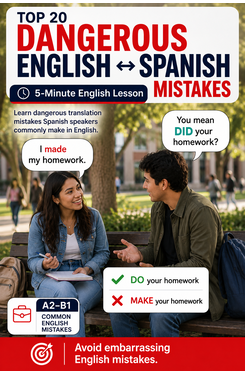
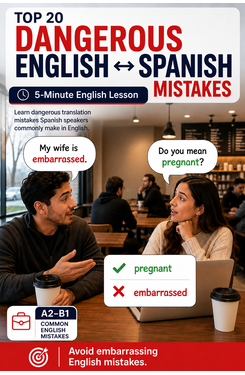
Some English words look like Spanish words, but mean something completely different. These are called false friends, and they cause misunderstandings.

read more